What’s changed?
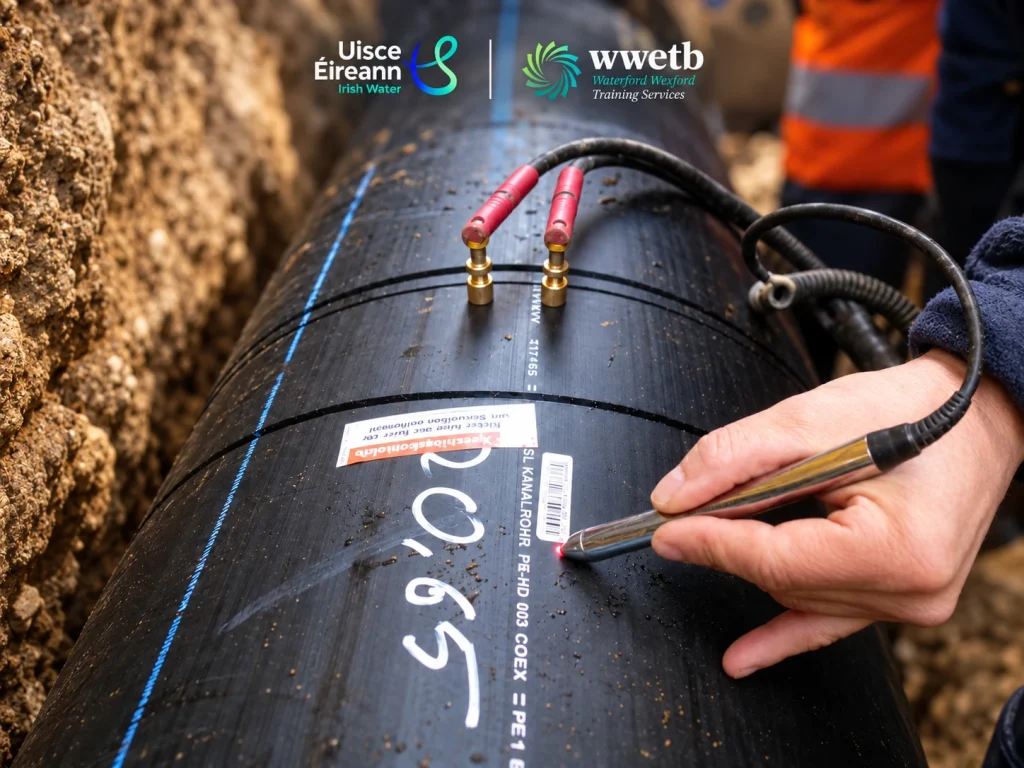
On 8 September 2026, Uisce Éireann issued Quality Alert ID-C-QA-04, introducing new requirements for polyethylene (PE) stub flange assemblies used on water infrastructure projects.
These assemblies are commonly used to connect PE pipework to valves, pumps, ductile iron fittings and other flanged equipment.
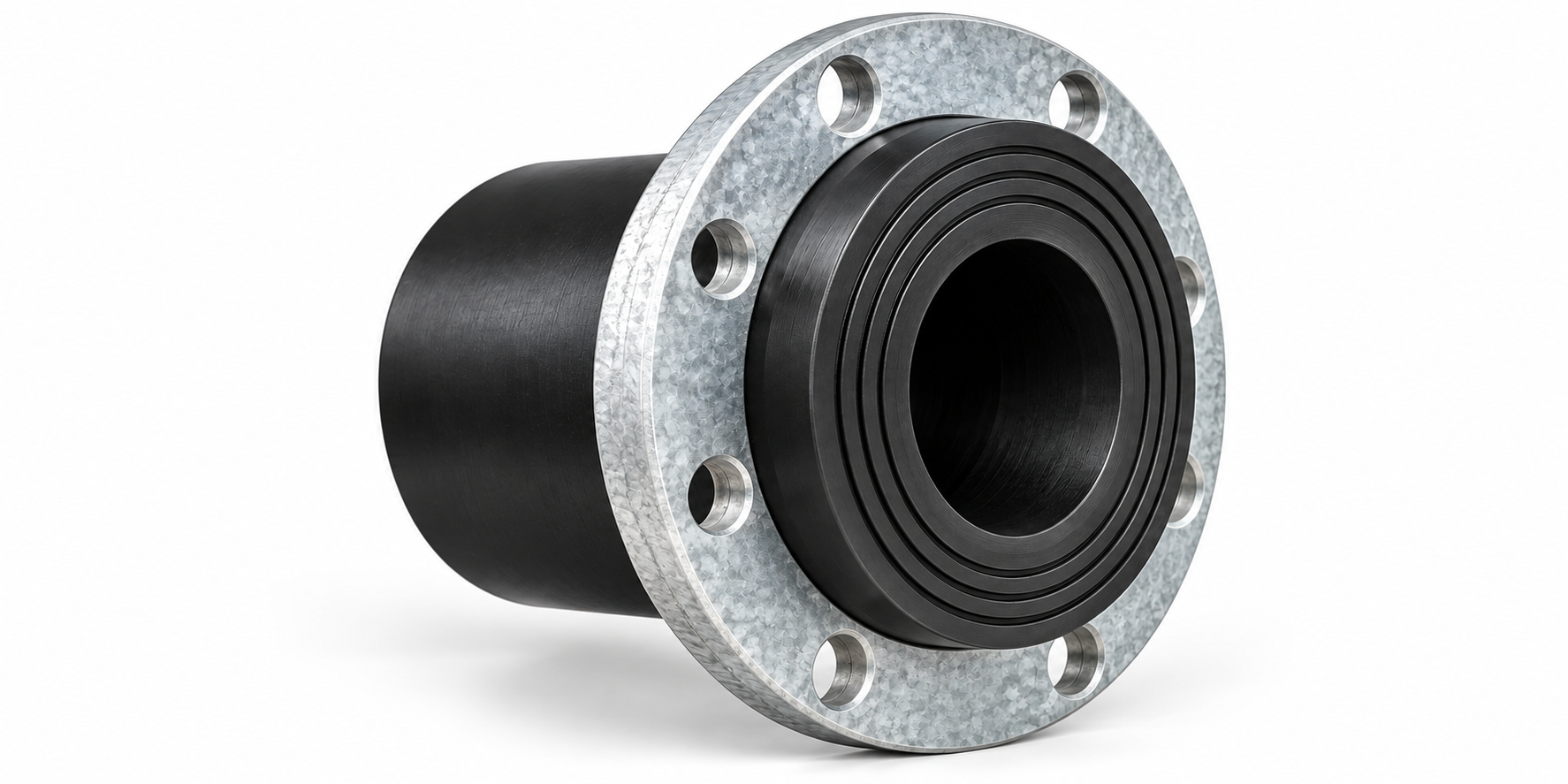
A conventional assembly consists of four main components:
- PE stub flange: The polyethylene fitting welded to the pipe.
- Steel backing ring: The loose flange used to secure the connection.
- Gasket: Provides the seal between the flange faces.
- Bolts: Hold the complete assembly together.
The new Quality Alert introduces specific minimum backing-ring thicknesses, requirements for pressure performance and third-party certification covering the complete assembly.
While the intention is to improve the quality and reliability of PE flange connections, several important technical questions remain unanswered.
The certification problem
One of the main challenges is the requirement for independent third-party certification of the complete flange assembly.
Manufacturers can generally provide certification for individual PE fittings, together with technical specifications for backing rings, gaskets and bolts.
However, certification covering the complete combination of all four components as one tested and approved system is a different matter.
At egeplast Ireland, we have been examining the new requirements and engaging with manufacturers and testing organisations.
Based on the information available to us, we have not yet identified a conventional PE stub flange assembly that can demonstrate compliance with every requirement exactly as written.
There is also a technical issue involving the standards referenced in the Quality Alert.
EN 12201-5 refers to ISO 17885 for mechanical joint performance, but ISO 17885 excludes loose flanges from its scope.
This creates uncertainty about the intended testing and certification route for conventional PE stub flange assemblies.
Uisce Éireann has clarified the manufacturer requirement
The original Quality Alert stated that the PE stub flange, backing ring, gasket and bolt set must be sourced from a single manufacturer.
Following correspondence with Uisce Éireann, clarification was provided confirming that individual components may come from different manufacturers, provided one manufacturer or vendor takes responsibility for the complete assembly and supplies the necessary certification and installation instructions.
This clarification is welcome and addresses one of the original concerns.
However, it does not resolve the wider issue of how complete flange assemblies are expected to achieve the required testing and certification.
Our main concern: backing-ring thickness and safety
One of the most concerning aspects of the new Quality Alert is the introduction of minimum steel backing-ring thicknesses that differ from established products used throughout the PE pipe industry.
The Alert specifies the following thicknesses:
| PE pipe outside diameter | Required backing-ring thickness |
|---|---|
| 90 mm | 20 mm |
| 125 mm | 22 mm |
| 180 mm | 24 mm |
| 250 mm | 26 mm |
| 315 mm | 29 mm |
To our knowledge, these particular thickness requirements are not used in other markets internationally.
As a result, backing rings manufactured to these specifications are not generally available as standard products and must instead be custom-made to order.
The fundamental concern is that we have seen no evidence that complete PE flange assemblies incorporating these newly specified backing rings have been performance-tested.
A PE flange connection is not simply a steel backing ring. It is a complete mechanical system in which the PE stub flange, backing ring, gasket and bolts must work together.
Increasing the thickness of the steel backing ring does not automatically improve the safety or reliability of the connection.
Changes to the dimensions and stiffness of a backing ring may affect how loads are distributed through the PE stub flange, how the gasket is compressed and how the complete assembly behaves under pressure.
Without appropriate testing, the consequences of these changes cannot simply be assumed.
Are contractors being asked to use untested assemblies?
We are receiving feedback from contractors suggesting that, in practice, particular attention is being given to enforcing the backing-ring thickness requirements.
If this is the case, it raises a serious question.
Why is a specific backing-ring thickness being enforced when there is no available evidence demonstrating that the resulting complete assemblies have been performance-tested?
The Quality Alert itself requires considerably more than a specified steel thickness.
It calls for the complete assembly to meet a working pressure of 16 bar and a test pressure of 24 bar, together with third-party certification demonstrating compliance with the specified EN 12201 requirements.
Simply replacing an established backing ring with a custom-manufactured thicker version does not demonstrate that these requirements have been satisfied.
In fact, it potentially introduces a new, unverified component combination into a pressurised pipeline system.
We are not suggesting that these thicker backing rings are inherently unsafe. However, without supporting test evidence, their performance as part of the complete assembly remains unverified.
Our position is that any change to an established flange assembly should be supported by appropriate technical evidence, particularly when that change is being introduced as a mandatory requirement for critical water infrastructure.
Safety and compliance must be established through the performance of the complete assembly, not by checking the thickness of one component in isolation.
Other outstanding technical questions
In addition to the backing-ring requirements, several issues still require clarification.
Pressure ratings and SDR classifications
The Quality Alert specifies a working pressure of 16 bar and a test pressure of 24 bar.
However, clarification is needed on how these requirements apply to different PE pipe pressure classes, particularly SDR11 and SDR17 systems.
It is also unclear whether separate testing and certification will be required for different SDR classifications.
Common PE pipe sizes
The Quality Alert specifies dimensions for OD90, OD125, OD180, OD250 and OD315.
However, other commonly used PE pipe sizes, including OD110, OD160, OD200, OD225 and OD280, are not specifically addressed.
This leaves questions about the intended flange dimensions, drilling arrangements and minimum thickness requirements for these sizes.
Certification of product ranges
It also remains unclear whether every individual pipe size and SDR classification must be separately tested, or whether testing of representative sizes could provide certification for a wider product range.
These are important considerations for manufacturers attempting to establish a practical certification process.
What does this mean for contractors?
For contractors working on Uisce Éireann projects, the immediate concern is avoiding delays, rejected materials and unnecessary replacement costs.
A conventional PE stub flange assembly may have an established history of successful use, with each component manufactured to its relevant standard.
However, that does not automatically mean it satisfies every requirement of the new Quality Alert.
Equally, replacing a backing ring with a thicker custom-manufactured alternative does not automatically establish compliance or prove that the complete connection will perform as intended.
Until the outstanding issues have been resolved, we recommend that contractors:
- Identify the complete proposed assembly, including the PE stub flange, steel backing ring, gasket and bolt set.
- Obtain the available manufacturer documentation, including relevant product certification, technical datasheets and installation instructions.
- Do not assume that a thicker backing ring automatically provides a safer or compliant connection.
- Seek written clarification or project-specific acceptance from Uisce Éireann where the proposed assembly cannot demonstrate full compliance with the Quality Alert.
- Request a formal derogation where necessary, identifying the exact manufacturer and component combination being proposed.
- Address these matters before ordering or installation to avoid unnecessary costs and programme delays.
Any derogation or project-specific acceptance should apply to the particular assembly being proposed. Acceptance of one manufacturer’s arrangement should not automatically be assumed to cover another.
Does this mean existing PE stub flange assemblies are unsafe?
No.
The introduction of new certification requirements does not, in itself, mean that conventional PE stub flange assemblies are defective or unsuitable.
Many established flange systems have been manufactured and used successfully for years.
The issue is the distinction between established product performance and the ability to demonstrate compliance with a newly introduced set of requirements.
Similarly, the fact that a newly specified backing ring is thicker does not automatically make it better or worse.
What matters is the performance of the complete connection, supported by appropriate testing, engineering assessment and certification.
That should remain the central consideration when evaluating any proposed changes to an established system.
What happens next?
egeplast Ireland has raised these concerns with Uisce Éireann and continues to engage with manufacturers and testing organisations to establish a practical and technically sound route to compliance.
We welcome the clarification already provided regarding the sourcing of components.
However, important questions remain about the certification process, the newly specified backing-ring dimensions and the evidence supporting their use as part of complete PE flange assemblies.
We support measures that genuinely improve the safety and reliability of water infrastructure.
However, requiring contractors to adopt custom-manufactured backing rings without demonstrated performance testing of the complete assembly risks replacing established engineering practice with an unverified specification.
Our position is straightforward: requirements intended to improve safety should be supported by clear technical evidence, appropriate performance testing and a realistic route to certification.
Until these issues are resolved, contractors should seek project-specific clarification and acceptance before proceeding with conventional PE stub flange installations that cannot demonstrate full compliance.
We will continue to provide updates as further information becomes available.
Download the full technical guidance
For contractors, designers and project engineers requiring further information, the following documents are available:
1. egeplast Ireland – PE Stub Flange Assemblies: Contractor Guidance
Our detailed technical review of the Quality Alert, including the outstanding certification issues, relevant standards and recommended procedure for requesting project-specific acceptance.
2. Uisce Éireann Quality Alert ID-C-QA-04, Revision 1.0
The original Uisce Éireann Quality Alert, effective 8 September 2026, outlining the requirements for PE stub flange assembly systems.
For technical assistance with PE stub flange assemblies or supporting documentation for project submissions, contact egeplast Ireland at info@egeplast.ie.